Try, for example, Pre-cleaning or Pile Cloth Filter.
Pile Cloth Drum filter
Highly efficient filtration with minimal operating costs Microfiltration and filtration
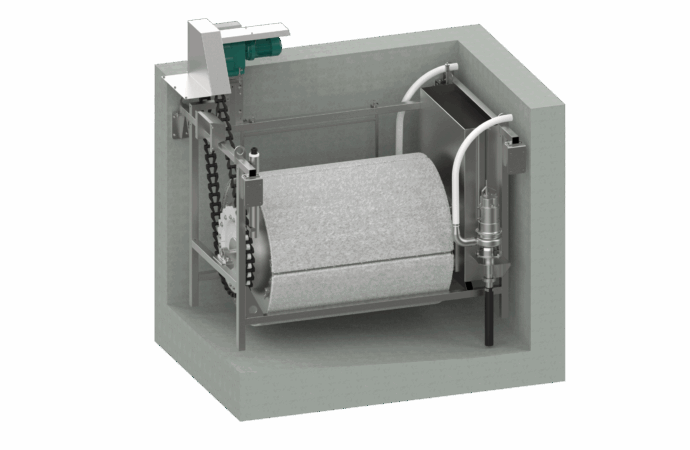
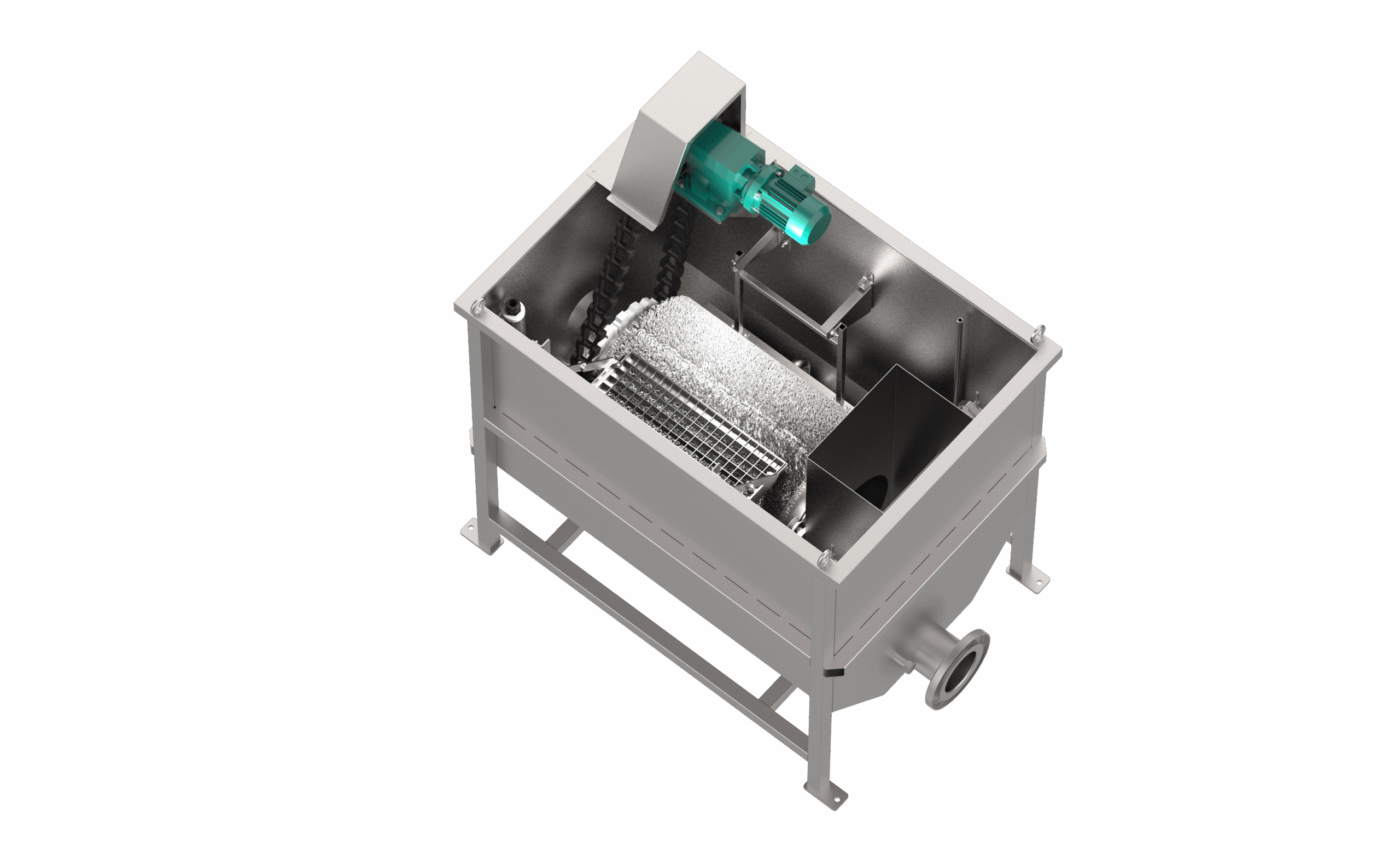
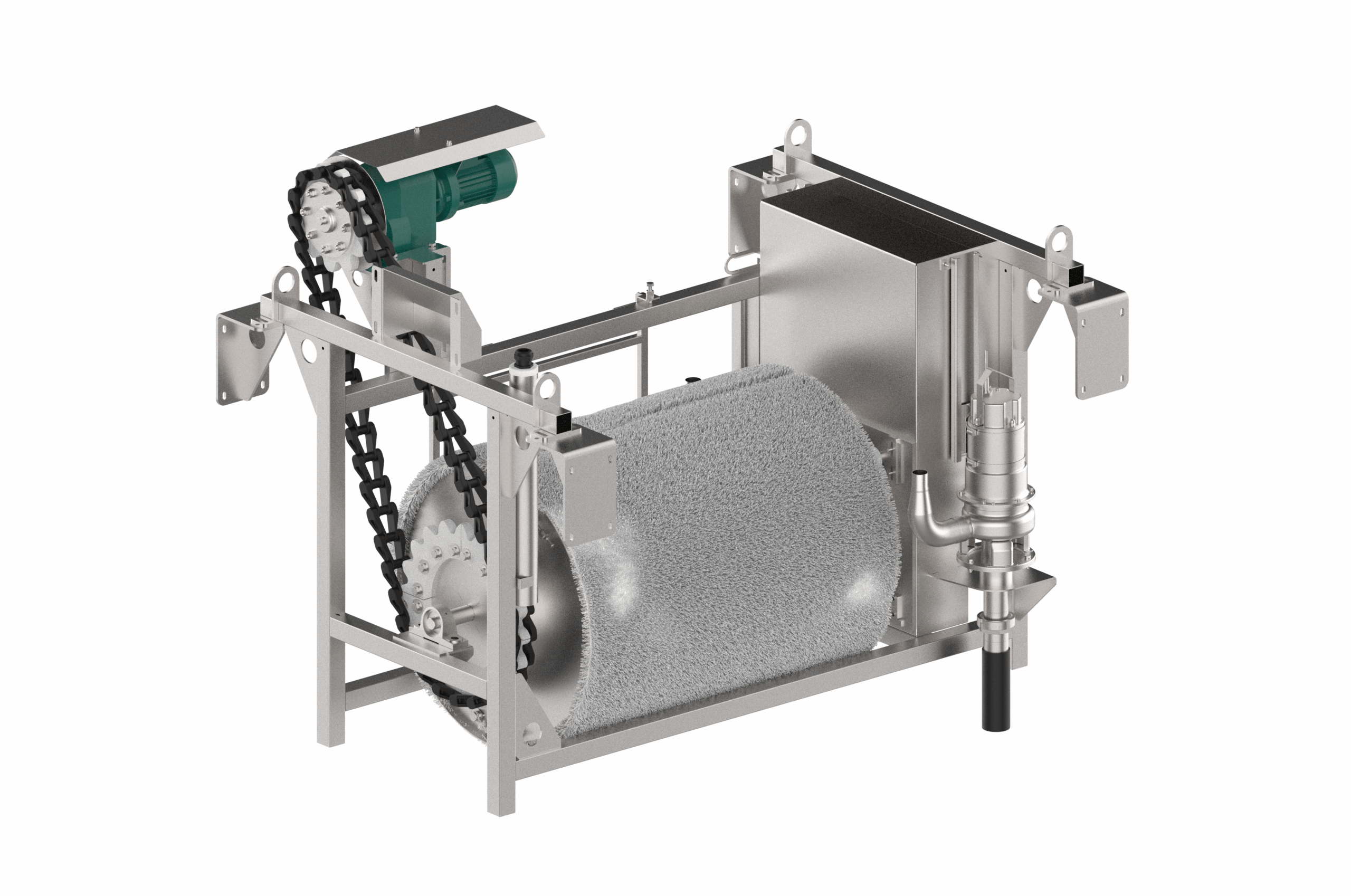
A filter operating on the OUT-IN filtration principle, a 100% submerged Pile Cloth Drum filter with filter cloth from 5 μm.
The Pile Cloth Drum filter guarantees maximum efficiency, TSS removal, BOD and COD reduction, phosphorus reduction down to 0.1 mg/l, and removal of micropollutants. It minimizes operating costs and the need for operator attendance.
Photos from apps
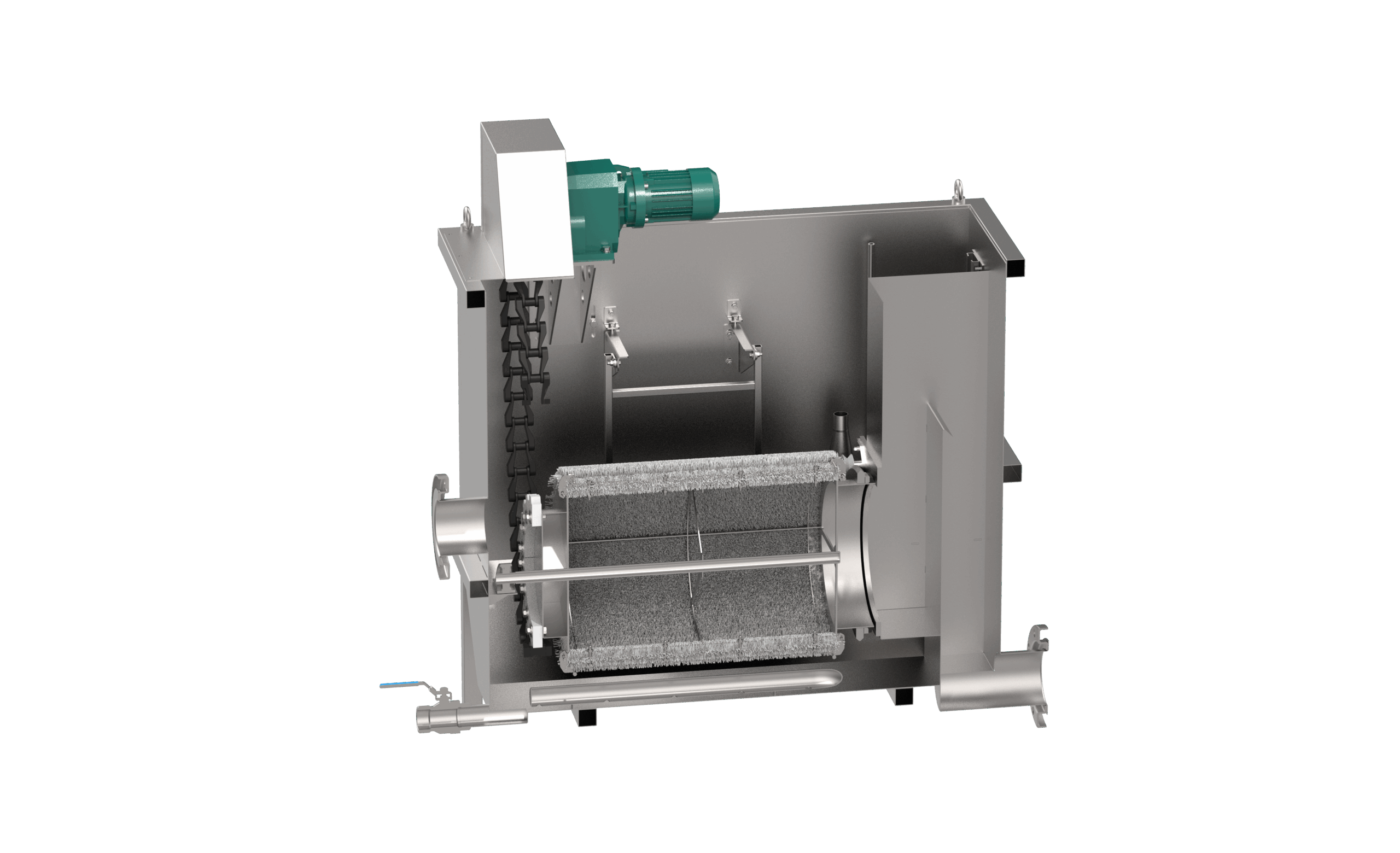
Filtration principle
OUT → IN, 100% use of filtration area
Filter cloth
from 5 μm
Design
stainless steel AISI 304 / 316 or higher
Filter cloth
Pile cloth filter cloth with long pile
Drum filtration area
1 sqm, 2 sqm, 4 sqm and 6 sqm
Control
level probe + PLC, SCADA connection, timer
Maximum hydraulic flow rate
90 cbm/h
Operating mode
continuous filtration
Installation
concrete channel / steel tank
Pile Cloth Drum filter for municipal and industrial operations
The Pile Cloth Drum filter is a high-performance new-generation drum filter that uses the OUT-IN filtration principle, specially developed long-pile cloth, and the possibility of sedimentation in the filter tank. This combination enables extremely efficient removal of suspended solids and organic particles even under high hydraulic and solids loading, where conventional filters are less effective.
The Pile Cloth Drum filter is designed for operations requiring large filtration capacity, low energy demand, and maximum operational reliability.
It is the ideal solution for municipal wastewater treatment plants, industrial operations, and influent water filtration where emphasis is placed on treated water quality and stable operation.
- Municipal wastewater treatment plants – the filter is suitable as a
- tertiary treatment stage – TSS removal, reduction of COD and BOD in the effluent, phosphorus reduction down to 0.1 mg/l. It is suitable for meeting strict discharge limits into receiving waters,
- quaternary treatment – use as pre-treatment for various PFAS removal technologies. The filter can be used in combination with powdered activated carbon dosing as a standalone quaternary stage.
- replacement of sand filtration – same or higher performance with dramatically lower energy and space requirements,
- filtration in areas with fluctuating hydraulic and solids loading – stable filter performance even during sudden increases in impurity concentration,
- optimization of existing WWTP operation – capacity increase without major civil works
- Industrial operations – the filter is especially suitable for
- food and beverage industry
- textile and paper industry,
- power generation and heating industry
- aquaculture
- drinking water treatment plants
Benefits of IN-EKO TEAM solutions
- size from as little as 1 sqm
- exceptionally low energy consumption
- low OPEX
- higher effluent water quality
- the filter is resistant to shock loads of Qmax and TSS
- large filtration capacity in a small footprint (100% submerged system)
- low maintenance
- exceptionally quiet operation
- long filter cloth service life (with no risk of tearing)
- continuous filtration even during cloth washing
- possibility of sedimentation in the filter tank
- excellent solution for industrial applications
- design allowing installation even with uneven concrete channels
- for two-stage filtration systems, possibility of combination with IN-OUT drum filters
- remote monitoring – Industry 4.0
Optional modifications
- installation of dry pumps
- folded overflow edge – increases filter capacity
- possibility of project-based modifications
- filter cover
Smarter operation through innovation
In cooperation with partners, we develop solutions that reduce environmental impact – from energy-efficient components to digitalized operation and remote equipment monitoring.
Sustainability as a foundation
From design to operation, our technologies are created to save resources, energy, and space. This is not a trend – sustainability is a natural part of every piece of equipment we develop.
Our goal is to ensure clean water for future generations.
Technology hub
Why IN-EKO TEAM?
IN-EKO TEAM is a Czech technology company with its own development and research department as well as its own manufacturing facilities. We design, manufacture, and supply top-class wastewater treatment equipment – from municipal wastewater treatment plants and industrial operations to aquaculture.
Our equipment is made of high-quality stainless steel and installed in more than 80 countries worldwide. Thanks to our long-term know-how, patented solutions, and precise workmanship, we offer our partners the reliability of efficient equipment with a long service life, together with after-sales service and commercial support.
We are your partner from the initial design through commissioning to subsequent service inspections.
O nás
How does the Pile Cloth Drum filter work?
Untreated water including impurities flows into the filter tank in which the filter drum covered with filter cloth is located. The whole system is 100% submerged. Untreated water passes through the filter cloth and all impurities are captured on its surface (deep-bed sand filtration principle). As impurities are retained on the filter cloth, water flow through the filter decreases and the water level in the filter tank gradually rises. When the level probe is activated, the washing process is initiated and the drum begins to rotate. This process involves slow rotation and suction removal of impurities.
Once the water level drops to the set minimum, the wash cycle ends and the filtration cycle repeats. Treated water flows to the downstream technology.
Filtration goes on continually without interruption.
Clean water is no coincidence.
It is technology.
WWTP
Aquaculture
Industry
Impurity
Removal of micropollutants and pharmaceuticals – quaternary treatment
Impurity
Removal of microplastics
Impurity
Removal of PFAS
Impurity
Phosphorus reduction (down to 0.1 mg/l)
Impurity
Removal of suspended solids – tertiary polishing
Impurity
BOD and COD reduction
Impurity
Removal of parasite eggs
Impurity
Compliance with new, stricter effluent discharge limits
Impurity
Ensuring the proper functionality of other systems for intensive phosphorus removal and quaternary treatment
Impurity
Pre-treatment before UV
Impurity
Reduction of OPEX
Products
 Pile Cloth filter...
 Vertical Pile Cloth filter
 Pile Cloth Drum filter
 “CLEVER” Disc...
 Microscreen Drum filter
 Robust Drum filter
 Containerized modular...
 Multifunctional unit –...
 Multifunctional unit –...
 Belt screen
 Straight Screw screen
 Circular Bar screen...
 Vertical Screw screen
 Vertical Bar screen
 Sand separator – SP
 Sand separator – SPG
 Screw press
 DAF Rectangular
Pile Cloth filter...
Vertical Pile Cloth filter
Pile Cloth Drum filter
“CLEVER” Disc...
Microscreen Drum filter
Robust Drum filter
Containerized modular...
Multifunctional unit –...
Multifunctional unit –...
Belt screen
Straight Screw screen
Circular Bar screen...
Vertical Screw screen
Vertical Bar screen
Sand separator – SPG
Screw press
DAF Rectangular
Impurity
Removal of suspended solids
Impurity
Reduction of operating costs
Impurity
Recirculation and reuse of process, cooling and stormwater
Impurity
Removal of suspended solids, algae and parasites in flow-through systems and influent water
Impurity
Ensuring optimal conditions for proper UV system performance
Impurity
Water recirculation in ZOOs
Impurity
Filtration in aquaponic systems